If you run a local business heading into 2027, here is the uncomfortable truth: a growing share of your customers get an answer before they ever see a website.
They ask “best plumber near me,” “what does a roof replacement cost,” or “who can install a mini split in Charleston,” and an AI hands back a tidy answer with a few business names in it. If you are not one of those names, you did not lose a ranking spot. You lost the lead, and you will never know it existed.
The good news is that most of your competitors still think “AI” is something you buy on Amazon with free shipping. This guide is the full playbook for getting your business named in ChatGPT, Gemini, Perplexity, Claude, Google AI Overviews and Google AI Mode. Almost everything in it also helps your regular Google rankings, so none of the work is wasted.
The short version
- AI answers name very few local businesses. In one 2026 study of more than 350,000 locations, ChatGPT recommended 1.2% of them.
- Each answer lists only a handful of names, usually two to four. Getting in is rare, which is why it pays.
- Nobody publishes a ranking formula for AI local recommendations. Anyone selling you “the secret” is guessing.
- What AI pulls from is knowable: your Google Business Profile, your listings, your reviews, your website and what other sites say about you.
- You can check where you stand today in about 15 minutes. The test is in Step 8.
What it means to “show up in AI answers”
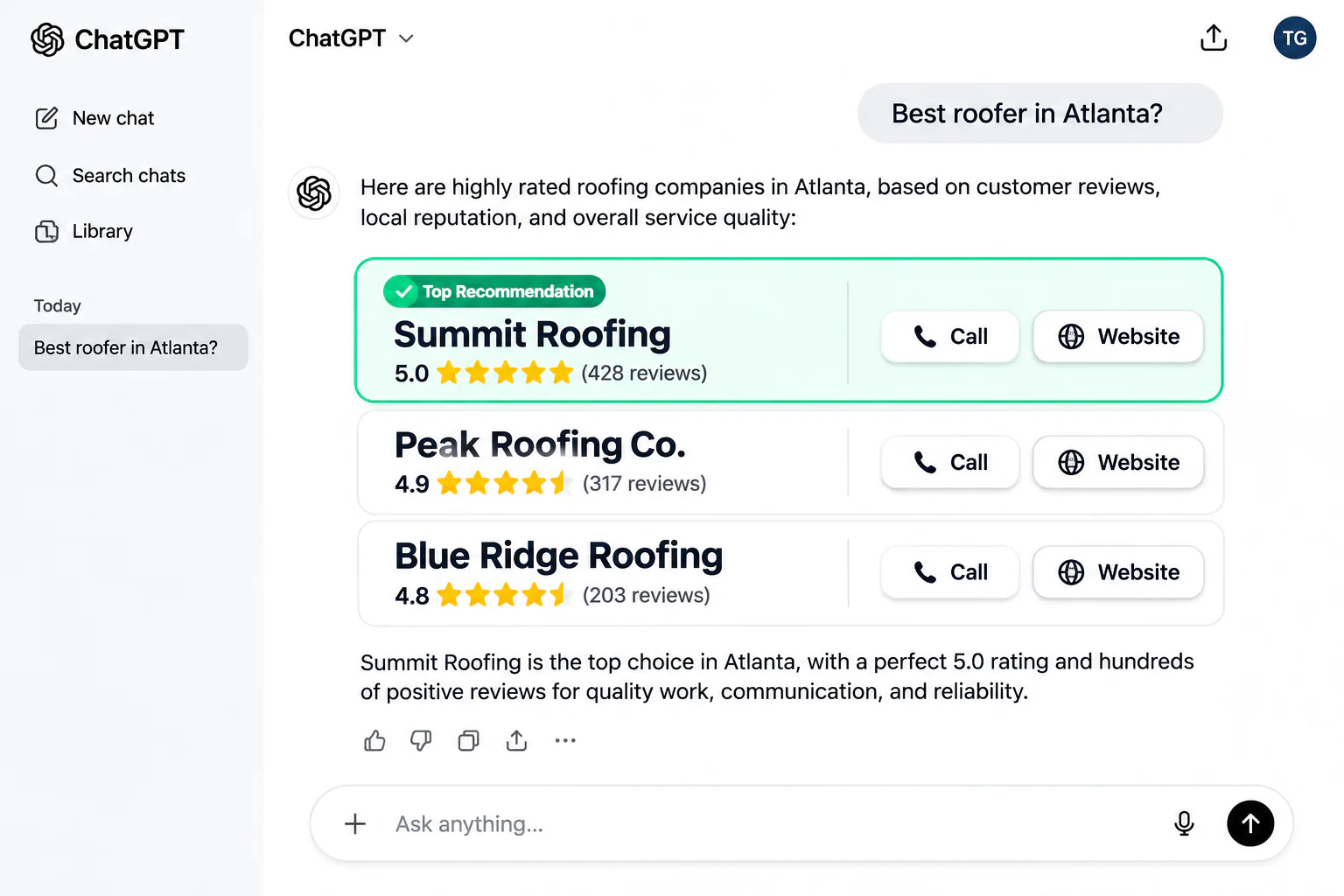
When people say “I want my business to show up in ChatGPT,” they usually mean one of these:
- The AI mentions my business by name when someone asks a local question
- It links to my website
- It recommends businesses like mine in my area
- And ideally, I get a call, form fill or booked job out of it
The catch is that AI platforms do not “rank” websites the way old-school Google did. They are not scrolling your site like a human and saying, “Ah yes, this is clearly the best HVAC company.” They pull from a mix of sources (your site, local listings, reviews, articles, directories and other places they treat as trustworthy), then write a summarized answer.
So the goal is not to trick the robot. The goal is to make it ridiculously easy for AI systems to understand who you are, what you do, where you do it and why you are credible.
Where local businesses actually stand right now
Before the how-to, a few numbers, because most advice on this topic skips them.
SOCi’s 2026 Local Visibility Index looked at more than 350,000 business locations. It found that ChatGPT recommended 1.2% of them, Perplexity 7.4% and Gemini 11%. For comparison, those same brands showed up in Google’s local 3-pack 35.9% of the time. The study also found business details were only about 68% accurate on ChatGPT and Perplexity, compared with 100% on Gemini, which is grounded in Google Maps.
BrightLocal reviewed 200,085 localized searches across ChatGPT, Google AI Mode and Google AI Overviews. Three findings matter for you:
- A tracked business appeared in Google Maps results in 66% of searches, but only 32% to 38% on the AI surfaces. Ranking well on Maps does not carry over automatically.
- ChatGPT averaged 4.1 businesses per response and AI Mode averaged 3.5. There are only a few seats at the table.
- Running the same prompt more than once produced noticeably different lists, with AI Mode and ChatGPT showing the biggest swings.
Searchable’s tracking points the same way: ChatGPT and Gemini often recommend different local businesses for the same question.
What to take from all of it:
- Being named is rare, so the businesses that earn it get a real edge.
- Your Google ranking and your AI visibility are two separate scoreboards. Track both.
- Check each platform on its own. Passing on one tells you nothing about the others.
- Think in terms of how often you appear across many prompts, not whether you showed up once.
The six places your customers are asking
Each tool works a little differently, and none of them publishes how it picks local businesses. Here is what is reasonable to know:
- ChatGPT runs live web searches for many local questions, so the pages, listings and reviews it can find about you matter.
- Gemini is grounded in Google Maps, according to SOCi’s study. For Gemini, your Google Business Profile is the main source of truth.
- Perplexity shows its sources next to the answer, which makes it the easiest tool for seeing which sites it trusts for your category.
- Claude can search the web too, and more people now use it for recommendations. Same fundamentals apply.
- Google AI Overviews are the AI summaries at the top of regular Google results.
- Google AI Mode is a separate, conversational tab on Google Search where people ask follow-up questions and get a longer answer with links.
The tools overlap heavily on what they read. That is why one set of fundamentals covers all six.
The big shift: search is becoming answers-first
Traditional search was like:
“Here are 10 blue links. Good luck.”
Now it is more like:
“Here is the answer. Also, if you are picky, here are some sources.”
For local businesses, this is huge, because local searches are often:
- urgent (“emergency plumber”)
- high trust (“best” or “top rated”)
- location-specific (“near me,” a city, a neighborhood)
- comparison-based (“price,” “reviews,” “open now”)
AI loves summarizing those. It also tends to lean on whatever information is easiest to verify. That is why local visibility in AI results comes back to three buckets:
- Your owned assets: website, service pages, FAQs, schema
- Your local footprint: Google Business Profile, Apple Maps, Bing Places, directories
- Your reputation and proof: reviews, mentions, links, citations
Win those three and you are in the conversation, literally.
How AI systems decide who to mention
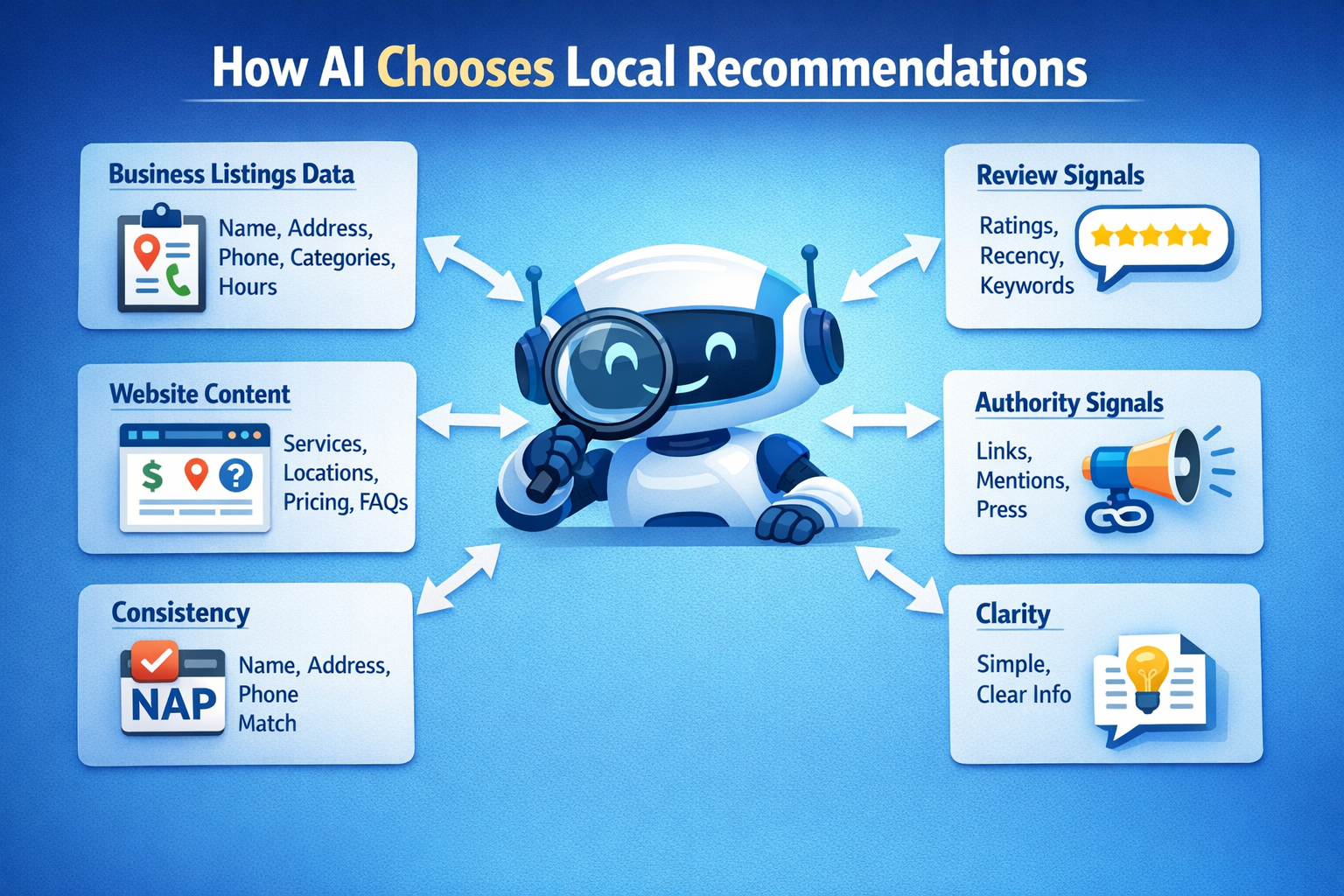
Each platform is different, but most AI local answers are built from some mix of these inputs:
- Business listings data: name, address, phone, categories, hours, service areas
- Review signals: volume, recency, star rating and the words customers use
- Website content: service descriptions, locations, pricing information, FAQs
- Authority signals: links, mentions, press, quality directories
- Consistency: your name, address and phone number (NAP) matching everywhere
- Clarity: plain language beats marketing poetry
Think of it like a group project (unfortunate, I know). If your business information is scattered, outdated or inconsistent, the AI picks the easiest teammate to work with, not the one who “could be great if you really got to know them.”
Your job is to be the easiest teammate.
Step 1: Make your website painfully clear
Your website does not need to be fancy. It needs to be understandable.
Here is the simplest test. Can someone landing on your homepage answer these in five seconds?
- What do you do?
- Where do you do it?
- Why should I trust you?
- What should I do next?
Now apply the same test to AI, which is basically a speed-reader with trust issues.
Website checklist for AI visibility
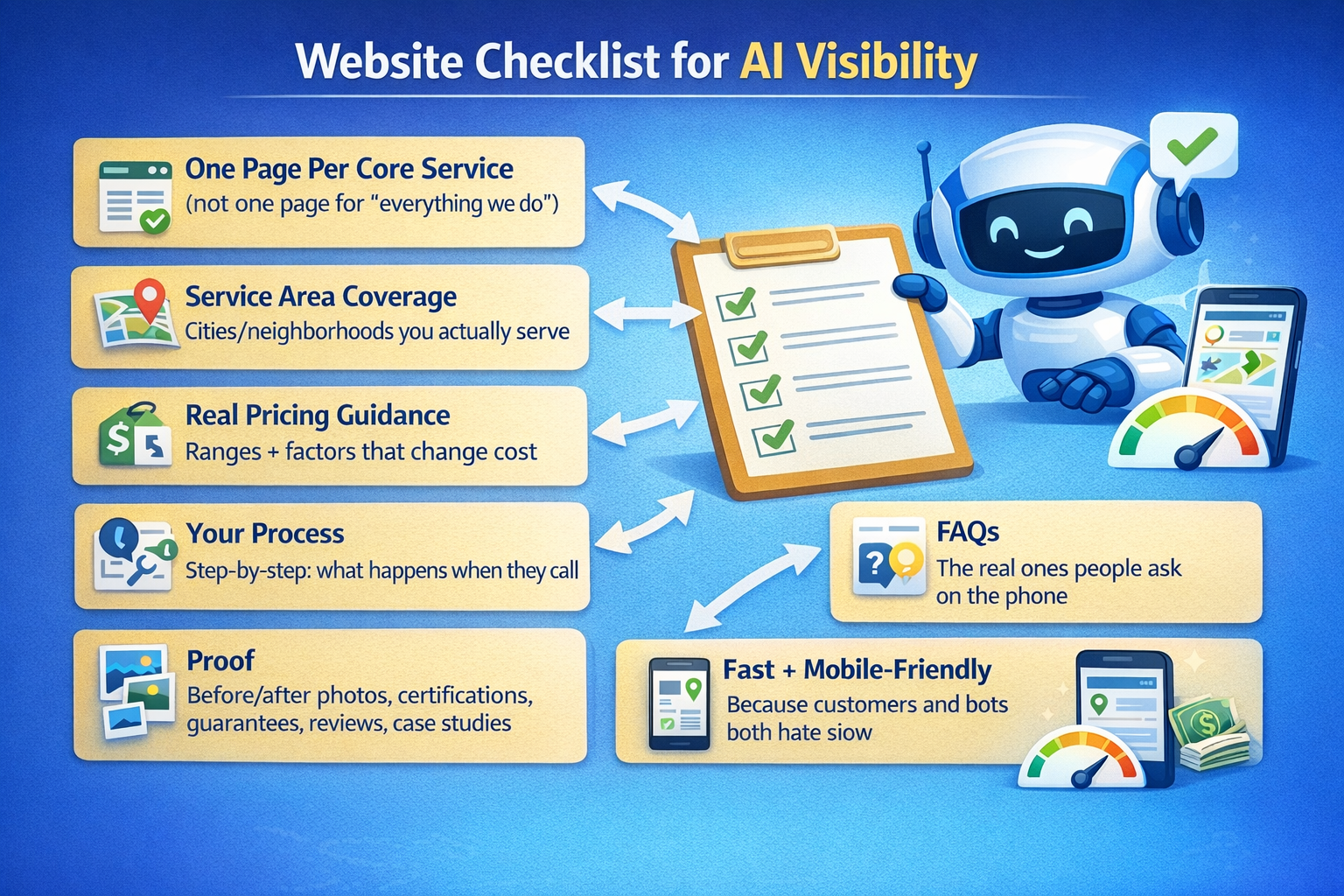
- One page per core service, not one page for “everything we do.”
- Real service area coverage. Name the cities and neighborhoods you actually serve, and give the big ones their own pages when you have something real to say about them.
- Honest pricing guidance. Ranges, plus the factors that move the price.
- Your process. What happens when someone calls, step by step.
- FAQs. The real ones people ask on the phone.
- Proof. Before and after photos, certifications, guarantees, reviews, case studies.
- Text, not pictures of text. If your hours, services or phone number live inside an image, a machine may never read them.
- Fast and mobile-friendly, because customers and bots both hate slow.
Don’t lock the bots out by accident
This one catches people. AI tools can only use pages they are allowed to fetch. Open your robots.txt file (yourwebsite.com/robots.txt) and make sure you are not blocking the major AI crawlers, such as OpenAI’s, Perplexity’s and Anthropic’s. Also check your host, security plugin or CDN. Some of them block unfamiliar bots by default, and nobody mentions it when you sign up.
If you only do one thing this month, do this: create or rewrite your top three service pages so each one reads like the clearest explanation of that service in your area. AI loves clarity. So do your customers.
Step 2: Treat your Google Business Profile like a money-printing machine
Your Google Business Profile (GBP) is still one of the strongest local truth sources on the internet. It matters twice over now. Gemini is grounded in Google Maps, and Google’s own AI results sit on top of the same business data.
GBP actions that actually matter
- Pick the right primary category. Do not get cute here. It is the single biggest signal on the profile.
- Add every service you offer, with a short description for each.
- Fill in your service areas honestly, and skip the cities you do not serve.
- Upload real photos on a schedule. Not once in 2019 and never again.
- Post updates, even short ones.
- Keep hours accurate, holidays included.
- Write the description in plain English and match it to your services and cities.
- Check the details monthly: phone, website link, appointment link.
If your GBP is half-baked, AI may still mention you, but it may mention you wrong. Nothing says “professional” like sending a lead to the phone number from three owners ago. SOCi’s data shows how common bad business details are on AI platforms. Make sure the bad data is not yours.
Step 3: Reviews are now SEO, conversion and AI fuel at once
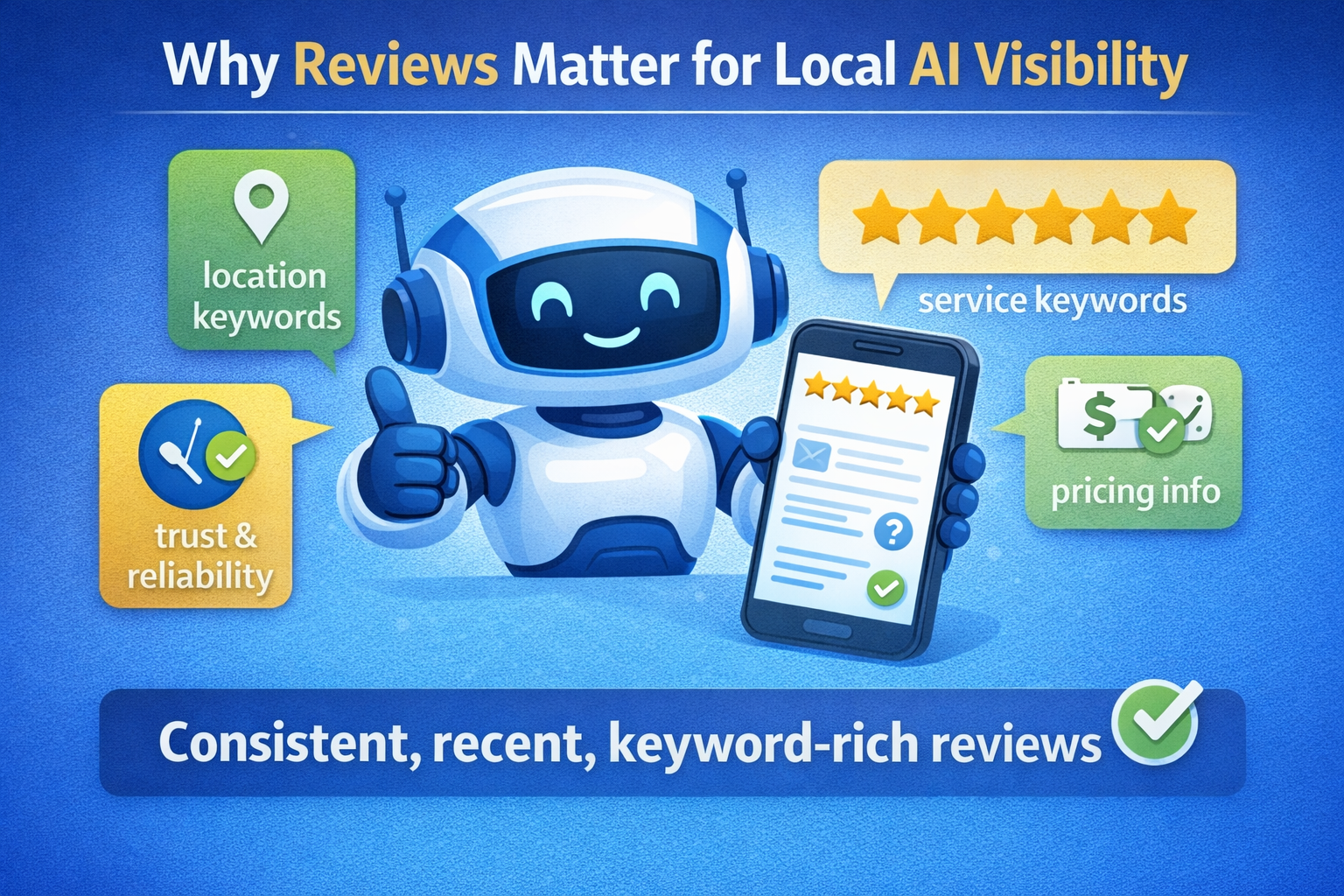
Reviews help you convert, and they also supply:
- service keywords (“water heater replacement”)
- location signals (“in Mount Pleasant”)
- trust (“showed up on time,” “priced fairly”)
- differentiation (“clean work,” “explained everything”)
In other words, reviews are little third-party mini-articles about your business, and AI systems love third-party confirmation. SOCi also found that the locations ChatGPT recommended averaged 4.3 stars, so ratings clearly count.
Review system basics (simple, not spammy)
- Ask every happy customer, and ask fast (same day or next day).
- Make it one click. Send a direct link by text, because nobody follows five steps to leave a review.
- Respond to every review, even the short ones. Use plain language and mention the service when it fits naturally.
- Aim for steady velocity: a few each week, not 30 in one week and then nothing for six months.
- Ask every customer, including the ones you are not sure about. Google’s rules prohibit filtering who gets invited to review.
- Never buy or fake reviews. The risk is not worth it, and fake ones tend to get caught.
Pro tip: if customers keep using the same words in reviews (“fast,” “honest,” “clean”), use those same words on your website. That alignment helps.
Step 4: Clean up your citations and listings
A citation is any place your business name, address and phone number appear online. The usual suspects:
- Google Business Profile
- Apple Maps (through Apple Business Connect)
- Bing Places
- Yelp and Facebook
- YellowPages and the Better Business Bureau
- Angi or HomeAdvisor, if relevant
- Industry directories and local chamber sites
AI systems and search engines use this web of listings to verify that you are real. If your listings disagree, with different suite numbers, old phone numbers or odd abbreviations, you are telling the internet, “I’m not sure who I am, but I think I’m a plumber?”
Bing deserves a quick call-out. It powers Microsoft Copilot and is widely reported to feed ChatGPT search, and plenty of owners have never claimed their Bing Places listing. It takes about 20 minutes.
Citation cleanup priorities
- Make your NAP 100% consistent, down to “Suite” versus “Ste.”
- Make sure your primary category matches reality on every platform.
- Use one website URL format everywhere (www or non-www, https).
- Update or remove old addresses and phone numbers.
- Claim the big platforms first: Google, Apple, Bing.
- Look for duplicate listings and merge or close them.
This is not sexy work. But neither is losing leads because your business is “kinda maybe” located somewhere you have not been since 2017.
Step 5: Add structured data so you are not relying on vibes
Schema is a structured way of labeling your information for search engines and AI systems. You are putting name tags on your content so it is easier to interpret.
At minimum, a local business should consider:
- LocalBusiness schema, with your name, address, phone, hours and service area
- Service schema for each core service
- FAQ markup on your real FAQ sections
- Review markup, carefully, and only for legitimate reviews you can display
You do not need to become a developer overnight. A good SEO plugin or your web developer can handle most of it. Be honest about what schema is, though: it reduces confusion, and it does not guarantee a mention. Think of it as removing a reason to skip you.
Step 6: Create content that AI can quote (and humans will read)
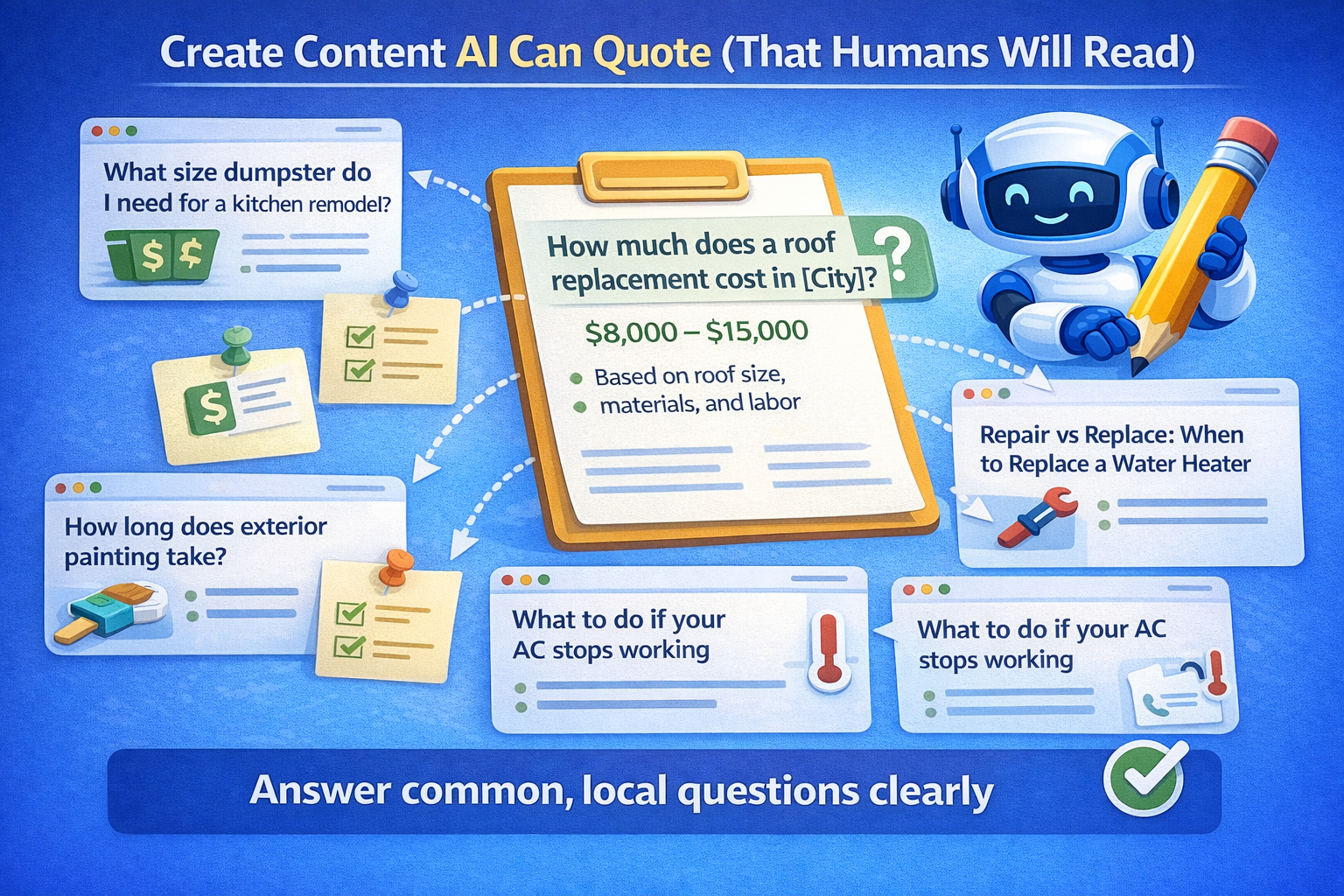
Here is the easiest way to win in AI answers: write the pages that answer the questions customers ask before they hire you.
Examples:
- “How much does a roof replacement cost in [City]?”
- “What size dumpster do I need for a kitchen remodel?”
- “Repair vs replace: when to replace a water heater”
- “How long does exterior painting take?”
- “What to do if your AC stops working”
These posts and service-page sections become quotable blocks. AI loves quotable blocks. Humans love not feeling clueless.
The content format that works best
- A short intro: what this is and who it is for
- The clear answer up top. Do not bury it.
- Pricing ranges and what affects the price
- The step-by-step process
- FAQs
- Common mistakes
- When to call a pro
- A call to action (book, call or request a quote)
Make it yours, or it is useless
Anyone can generate a generic “how to choose a roofer” article in 30 seconds, including your competitors and the AI itself. The pages that get quoted carry details a generic page cannot have: your real price ranges, the neighborhoods you work in, photos from actual jobs, the permit rules in your county, the mistakes you see on every second estimate. Add what only you know.
Step 7: Build authority beyond your website
AI systems give more weight to what other places say about you than to what you say about yourself.
That can include:
- links from local news sites and publications
- sponsorship pages for the teams and events you support
- supplier and manufacturer dealer directories
- neighborhood and trade associations
- local awards pages
- partner and referral pages
- podcast or press features
- real, helpful answers in local community groups and forums
You do not need to go viral. You need a handful of credible mentions that confirm you are a real, reputable local business. Think “boring authority,” the best kind. A quick way to start: look at who the AI already cites for your category (Perplexity shows its sources) and see which of those sites would list or feature a business like yours.
Step 8: Test, track and keep going
You cannot improve what you never check. Set aside 15 minutes and do this:
- Open ChatGPT, Gemini, Perplexity, Claude and Google (for AI Overviews and AI Mode), each in its own window.
- Ask the same five to ten questions in each. Use the way a customer would phrase it: “best [your service] in [your city],” “who is the most affordable [your service] near [neighborhood],” “emergency [your service] open now in [city],” “[your service] cost in [city].”
- Write down who gets named, in what order, and which sources get cited.
- Repeat the same prompts in a few weeks. Answers shift from run to run, so you are watching the pattern, not one result.
Also look for what the AI gets wrong. A wrong phone number, a closed location or a missing service is a clue to which listing needs fixing.
Tracking the leads that come from AI
- In Google Analytics, check your referral traffic for sources like chatgpt.com, perplexity.ai, gemini.google.com and claude.ai. The numbers will be small. Watch the trend.
- Add “How did you hear about us?” to your forms and your phone script, with “ChatGPT or another AI tool” as an option.
- Use call tracking so you can tie phone calls back to the source. For many local businesses, the phone is where AI-referred leads show up.
One honest caveat: much of the time a person asks an AI, gets your name, then searches for you directly on Google. That shows up as a branded search or a direct visit, not as an AI referral. If your branded searches climb while your other traffic holds steady, AI may be doing its job.
Mistakes that keep businesses invisible
- Letting listings drift out of sync after a move, a rebrand or a new phone number
- Choosing a primary category that sounds better than it fits
- One thin “Services” page instead of a page per service
- Blocking AI crawlers without knowing it
- Buying reviews, or only asking customers who are sure to say yes
- Publishing mass-produced AI filler and expecting it to get cited
- Chasing “AI hacks” while the Google Business Profile has not been touched in a year
- Checking visibility once, panicking or celebrating, and never looking again
The 14-day action plan
If you want a simple sprint that actually moves the needle, here it is.
Days 1-3: Foundation
- Audit your website messaging: what, where, trust and next step
- Fix any wrong contact information
- Make sure you have dedicated pages for your top three services
- Check robots.txt and your security settings for blocked AI crawlers
- Run the baseline test from Step 8 and save the results
Days 4-7: Local footprint
- Fix your GBP categories, services, service areas, photos and description
- Claim or fix your Apple Maps and Bing Places listings
- Start citation cleanup on the top directories
Days 8-10: Proof and conversion
- Put your best reviews on your service pages
- Set up a one-click review request for every finished job
- Add a “How it works” section to each service page
- Add clear calls to action (“Call,” “Get a Quote,” “Schedule”)
Days 11-14: AI-quotable content
- Publish one pricing post, with ranges and the factors that change them
- Add 8 to 12 real FAQs to your top service page
- Add or update schema (or have your developer do it)
After day 14: the monthly rhythm
- Rerun your test prompts and compare against the baseline
- Post a few GBP updates and fresh job photos
- Request reviews continuously, and answer new ones within a couple of days
- Publish one new answer-style page or post
- Earn one new local mention or link
If you do nothing else, do that. It is the “I want leads, not homework” plan.
Frequently asked questions
Can I pay to be recommended by ChatGPT or Gemini?
Not for organic recommendations. Nobody sells a way to buy your way into the answer, so be skeptical of anyone who claims to. What you can do is earn the mention with accurate listings, strong reviews and clear content.
How long does it take to see results?
Listing fixes and Google Business Profile changes can show up within weeks. Reviews, content and local mentions take longer, usually a few months of steady work. Because AI answers vary from run to run, judge progress over a month or two of testing.
Is AI search replacing Google?
Not yet for most local searches. Google is still where most people look for a local business, and AI Overviews and AI Mode now live inside it. Treat AI as another place customers find you, and keep your Google basics strong.
Why does AI give different answers each time I ask?
These systems generate each answer fresh, so the list of businesses can shift between runs. That is why you test several prompts and look at the pattern instead of trusting a single answer.
Do I need schema markup to show up?
No. Plenty of businesses get mentioned without it. It helps machines read your information correctly, so it is worth doing, but it will not rescue a weak profile or a vague website.
Can I use AI to write my content?
For a first draft or an outline, sure. For anything you publish, add your own prices, photos, local details and real experience before it goes live. Generic copy is the thing AI has the least reason to quote.
Which matters most: my website or my Google Business Profile?
For most local service businesses, start with the Google Business Profile and your reviews, since Gemini and Google’s AI results lean on that data. Then make your website the clearest source on the web about what you do. You need both, but the profile is usually the faster win.
The bottom line: AI optimization is mostly local SEO done properly
I know that is not as exciting as “10 secret AI hacks the gurus don’t want you to know.” But it is better news. You do not need to reinvent your marketing. You need to tighten up the fundamentals so AI systems can recommend you with confidence.
If your business information is consistent, your website is clear, your reviews are strong and other sites vouch for you, you are exactly the kind of business AI tools want to name. And the odds are good that most of your competitors will not bother. They will keep posting blurry photos of their truck from 40 feet away, and you are going to like 2027.
Want help making your business show up in AI answers?
If you want this done for you (website, local SEO, reviews and tracking), we can build the whole system so you are not duct-taping tools together at 11:47 PM wondering why the phone is not ringing.
Because the only robot you should be dealing with is the one vacuuming your floors, and even that one gets stuck under the couch sometimes.

Talk to Todd
Want us to take care of all of it for you?
Tell us what you sell and where you work. We’ll tell you straight whether we can help.
Sources
Did you get value from this post? Please share it!