
You did everything right. You showed up on time, wiped your boots, measured twice and sent a clean quote that same night. The homeowner said “this looks great, we’ll be in touch.” That was eleven days ago. Since then, nothing. You’ve checked your phone more often than a teenager waiting on a prom date.
Welcome to getting ghosted. Every contractor has been there, and most of them handle it the same way: one follow-up text, maybe a second, then they write the job off and complain about it at the supply house. That’s the expensive mistake. A quiet homeowner usually just hasn’t decided yet, and the contractor who’s still around when they do decide gets the job.
The 30-second version
- Most homeowners who go quiet just haven’t decided yet.
- Six things usually cause the silence, and only one of them means you lost the job.
- Book the next call and talk price before you leave the estimate.
- Follow up on a schedule (same day, then days 3, 7, 14 and 30) with something useful each time.
- Let a CRM send the follow-ups so the job doesn’t depend on your memory.
- Copy-and-paste follow-up texts, a voicemail script and an email template are below.
What’s actually going on in that silence
Here’s the thing nobody tells you: the homeowner isn’t sitting at the kitchen table thinking about your quote. They’re thinking about soccer practice and why the dishwasher is making that noise. Your $28,000 kitchen is one tab open in a browser with forty other tabs. Here’s what’s usually behind the silence.
- The number scared them. They had a figure in their head (usually whatever a TV show told them) and yours was bigger. Most people would rather disappear than say “that’s more than we thought.”
- The other decision-maker hasn’t weighed in. You met one spouse. The other one hasn’t looked at the quote, or looked at it and said “let’s talk about it after the holidays.”
- They’re still collecting bids. You were first. Two more contractors are coming out next week, and they won’t say a word until they’ve seen everyone.
- They’re stuck on something you didn’t explain. Your quote made sense to you. To them, “R-38 batts, 2×6 sister joists” reads like a ransom note. Confused people don’t buy. They stall.
- Life got in the way. A sick parent or a surprise transmission bill. The project is parked until things settle down.
- They hired somebody else. And telling you feels awkward, so they just don’t.
Notice that only one of those six means you lost. The other five mean “not yet.”
The awkward truth: you might be ghosting them too
When a homeowner goes quiet, a lot of contractors send one “just checking in!” text and then wait for the homeowner to make the next move. From the homeowner’s side, that looks like the contractor lost interest. So now you’ve got two people both waiting for the other one to call, which is how a lot of good jobs (and a few marriages) quietly die.
Five or six follow-ups over a few weeks, each with something useful in it, makes you the most organized contractor they talked to. That’s a pretty low bar, and most of your competition trips over it.
Stop it before it starts: do this before you leave the driveway
The best follow-up starts during the estimate.
- Book the next conversation on the spot. Don’t leave with “we’ll be in touch.” Leave with “I’ll call you Thursday at 6 to walk through the numbers. Does that work?” Now you’ve got an appointment.
- Ask who else needs to see it. “Is anyone else part of this decision?” If the answer is yes, offer to go over the quote with both of them on a quick call.
- Ask about other bids. “Are you getting other quotes? When do you expect to decide?” They’ll usually tell you, and then you know when to call back.
- Talk money early. Give a ballpark range before you write the formal quote. If they flinch at the range, you can talk about options right there instead of finding out through silence.
- Write the quote for a normal human. Use plain language and put a short summary at the top. Save the spec sheet for page two.
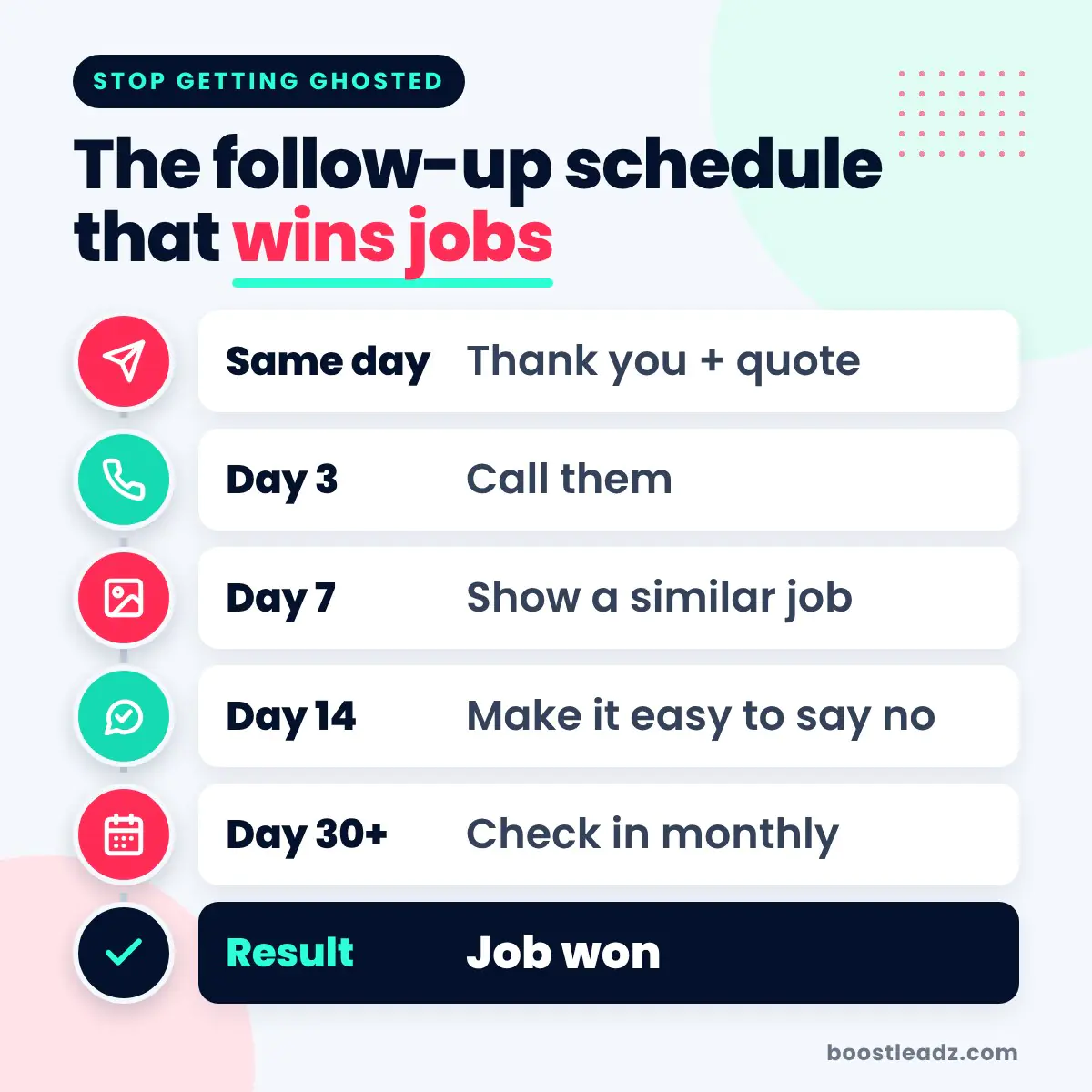
A follow-up schedule that isn’t annoying
If they still go quiet, run a schedule instead of winging it. Here’s one that works without making you the guy they block.
- Same day: A short thank-you text or email with the quote attached again and a one-line recap of the job. Make it easy to find later.
- Day 3: Call. Ask if they had a chance to look it over and if anything was confusing. If they don’t answer, leave a 20-second voicemail and send a text saying you called.
- Day 7: Send something helpful: photos of a similar job you finished, or your financing options if price came up.
- Day 14: Make it easy to say no. “Totally fine if you went another direction or the timing’s off. Just let me know either way so I don’t keep bugging you.” This is often the one that finally gets a reply, because you’ve given them permission to be honest.
- Day 30 and monthly after: If they said “not now,” keep a light touch. Something like “we have an opening in March if you’re still thinking about it.” Plenty of jobs close six months after the estimate.
How long should you wait to follow up on a quote?
Not long. Send a short text the same day the quote goes out, then follow up again two or three days later. That second touch is the one most contractors skip, and it lands while the homeowner is still comparing bids and your quote is still fresh in their head. After that, space things out: once a week for two weeks, then once a month.
The reason speed matters is that homeowners shop around. In a Modernize homeowner survey, 63% said they compare three or more quotes before picking a contractor. Go quiet for a week and you’re letting the other two contractors do all the talking.
One exception: if you set a time during the estimate (“I’ll call you Thursday at 6”), that beats any schedule in this post. Keep the promise you made in their kitchen.
Follow-up text and email templates you can steal
Copy these, swap in your own details and send them from your phone or your CRM. Keep texts short. If it doesn’t fit on a phone screen without scrolling, it’s an email.
Same-day text after you send the quote
Day 3 voicemail script
Most homeowners won’t call back a voicemail, so don’t ask them to. Tell them what happens next instead.
Day 7 text: add something useful
Day 14 text: close the loop
This one tends to get people to finally answer, because it lets them off the hook.
Follow-up email after sending a quote
Hi Sarah,
Thanks again for having me out Monday. Your quote is attached.
The question I get most on this kind of job is how long it takes. For your house, plan on one day for tear-off and install, plus half a day for cleanup and the final walkthrough.
If anything in the quote doesn’t make sense, reply here or text me at 555-123-4567. I’d rather explain it now than have it sit in your inbox.
Mike
Day 30 check-in text
What to say when they finally reply
The whole point of follow-up is getting a reply. Here’s how to handle the answers you’ll hear most.
- “It’s more than we expected.” Say: “Totally fair. What number did you have in mind?” Then talk about options, like a smaller scope or doing the work in two phases. Change the job and keep your price.
- “We’re still getting quotes.” Say: “Makes sense. When do you plan to decide? I’ll check back after that.” Then remind them to compare apples to apples, like whether every quote includes permits and a warranty.
- “We need to talk it over.” Say: “Of course. Want to set up a 10-minute call with both of you? I can answer questions directly, and it beats playing telephone.”
- “We went with someone else.” Say: “Thanks for letting me know. I hope it goes great, and you’ve got my number if anything comes up.” Then check in after their project should have wrapped. Jobs fall through, and you want to be the second call.
Should you call, text or email?
Use whatever the homeowner used to reach you, and ask at the estimate how they’d like to hear from you. People are split pretty evenly. In Modernize’s 2025 Homeowner Insights Report (as reported by Joist), about 30% of homeowners preferred a phone call for first contact with a contractor, 29% preferred a text and 26% preferred email. No single channel covers everyone, so mix calls and texts and save email for anything long.
What not to do
- Don’t guilt trip. “I spent two hours out there” is true and nobody cares. It makes you sound bitter.
- Don’t drop your price right away. A discount nobody asked for tells them your first number was padded. Offer options instead, like a smaller scope or doing it in two phases.
- Don’t send the same text five times. If every message says “just following up,” you’re a reminder they want to snooze.
- Don’t quit after two tries. This is the big one. Two unanswered messages is not a no.
Let software do the nagging
The catch is that you’re running jobs and putting out fires all day. Nobody remembers to send a day 7 text to a homeowner from three weeks ago. That’s where most follow-up dies. Contractors care. They’re just busy.
A simple CRM fixes that. When an estimate goes out, the texts and call reminders start on their own and go out on schedule. When the homeowner replies, the automation stops and you take over. You look organized, and you didn’t have to set eleven phone alarms. It’s the reason we built CloseLeadz for home service businesses.
If you’re paying for leads through Google Ads or anywhere else, this matters even more. Every lead you let go cold is money you already spent.
Track your close rate so you know what to fix
You can’t fix what you don’t count. Keep a running tally of quotes sent and jobs won. Divide jobs won by quotes sent and that’s your close rate. Check it once a month.
Then look at where quotes die. If most go quiet right after the first visit, the problem is the estimate itself, so work on clearer quotes and talking money earlier. If they go quiet after a week, your follow-up needs work. And if you’re losing on price after a full conversation, that’s a pricing problem. No amount of clever texting fixes that one.
Quote follow-up FAQs
How many times should you follow up on a quote?
Plan on five or six touches over about a month, then move the homeowner to a monthly check-in. Stop when they say no or ask you to stop.
Is it OK to text a customer about an estimate?
Yes, as long as they gave you their cell number and said texting is fine. Ask at the estimate: “Is it OK if I text you about the quote?” If you send texts from a business texting platform, name your company in the first message and include a way to opt out, like “Reply STOP to opt out.”
Should I lower my price if a homeowner ghosts me?
No. Find out what’s in the way first. If it really is money, change the scope instead of the price so your number stays honest.
What’s a good follow-up text after an estimate?
Short and specific, with one easy question to answer. Mention the job and add one useful detail. The templates above are a good starting point.
When should you stop following up?
When they say no or ask you to stop. If three months go by with no reply, switch to a seasonal email a few times a year. That keeps your name around without making you a pest.
The bottom line
Most ghosted quotes are decisions that haven’t happened yet. Set the next step before you leave the driveway and follow up on a schedule, with something useful every time. Do that and you’ll close jobs your competitors gave up on two texts ago.

Talk to Todd
Tired of chasing quotes by hand?
We set up follow-up that runs on its own, so cold leads get a second chance. Tell us about your business and we’ll tell you straight whether we can help.
Did you get value from this post? Please share it!